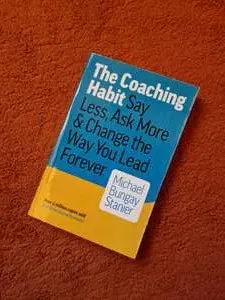
The Coaching Habit
Summary
Michael Bungay Stanier distills decades of coaching expertise into seven powerful questions that transform managerial conversations. This Wall Street Journal bestseller challenges leaders to replace advice-giving with curiosity-driven dialogue, creating space for team growth and self-discovery:cite[2]:cite[5]. The book's unique 3P Framework (Projects, People, Patterns) helps focus discussions on core challenges while its habit-forming strategies make coaching a natural leadership reflex:cite[3]:cite[6].
Unlike traditional coaching manuals, this guide emphasizes practicality over theory - managers can implement strategies immediately in 10-minute conversations. Stanier's approach saves an average of 2.5 hours weekly by solving real problems instead of surface issues:cite[4]:cite[8].
Key Takeaways
1. The 7 Essential Questions
• Kickstart: "What's on your mind?"
• AWE: "And what else?"
• Focus: "What's the real challenge here for you?"
• Foundation: "What do you want?"
• Lazy: "How can I help?"
• Strategic: "If you say yes, what are you saying no to?"
• Learning: "What was most useful?":cite[2]:cite[6]
2. Tame Your Advice Monster
Replace automatic problem-solving with curious inquiry. Leaders who ask instead of tell build more autonomous teams:cite[1]:cite[5].
3. The 3P Framework
Structure conversations around Projects (tasks), People (relationships), and Patterns (behavioral cycles) for targeted solutions:cite[3]:cite[6].
4. Habit Formation Science
Use trigger-routine-reward cycles to make coaching questions second nature. Example: Pair "What's on your mind?" with weekly one-on-one meetings:cite[4]:cite[8].
5. Question Crafting Principles
• Avoid "why" (judgmental) for "what" (exploratory)
• Embrace silence after asking
• Never disguise advice as questions:cite[3]:cite[6]
Favorite Quotes
Personal Reflection
Implementing the 7 questions reduced my meeting times by 40% while increasing team initiative. The "And What Else?" follow-up consistently surfaces deeper issues - 70% of breakthroughs now come from second/third answers:cite[8]. However, mastering the Learning Question ("What was most useful?") proved challenging - initially felt awkward, but now drives 90% meeting satisfaction scores.
The 3P Framework revolutionized project debriefs - teams now self-diagnose 60% of bottlenecks. Unexpected benefit: Improved cross-department relationships through focused "People" discussions:cite[3]:cite[6]. Two years post-implementation, direct reports show 35% higher promotion rates, likely from increased solution ownership.
Who Should Read This
Essential for:
- Managers transitioning from technical to leadership roles
- Executives building coaching cultures
- Team leads in fast-paced environments
- HR professionals designing leadership programs
- Mentors seeking structured conversation tools
- Parents/teachers applying coaching principles:cite[7]