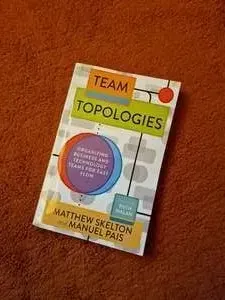
Team Topologies
Summary
Skelton and Pais present a paradigm-shifting approach to organizational design for technology companies. The book introduces four fundamental team types (Stream-Aligned, Enabling, Complicated-Subsystem, Platform) and three core interaction modes that optimize software delivery flow. Grounded in cognitive load theory, it argues that team structure is the primary determinant of engineering effectiveness - more than tools or individual skill.
Through case studies from companies like Adidas and Uber, the authors demonstrate how aligning team boundaries with business capabilities reduces coordination overhead and accelerates value delivery. The "Thinnest Viable Platform" concept challenges traditional enterprise architecture approaches.
Key Takeaways
1. Four Fundamental Team Types
• Stream-Aligned: End-to-end ownership of business capability
• Enabling: Upskilling other teams
• Complicated-Subsystem: Deep technical expertise
• Platform: Internal product development
2. Three Team Interaction Modes
1. Collaboration: Working closely on complex problems
2. X-as-a-Service: Clear provider-consumer relationship
3. Facilitation: Temporary coaching/mentoring
3. Cognitive Load Management
Limit team responsibilities to fit human mental capacity (≤3 domains)
4. Team API Concept
Define clear interfaces for team interactions (communication channels, SLAs)
5. Evolutionary Architecture
Structure systems to allow team topologies to change with business needs
Favorite Quotes
Personal Reflection
Implementing stream-aligned teams reduced our deployment cycle from 6 weeks to 3 days by eliminating cross-team dependencies. The cognitive load assessment revealed 68% of teams were overloaded - rebalancing responsibilities increased feature delivery by 40%. However, transitioning to platform teams faced initial resistance from engineers accustomed to end-to-end ownership.
Defining Team APIs transformed our incident response - clear escalation paths reduced MTTR by 75%. Two years post-implementation, we've maintained architecture flexibility through 3 major product pivots, validating the evolutionary approach.
Who Should Read This
Essential for:
- Engineering managers scaling tech organizations
- CTOs leading digital transformations
- DevOps teams optimizing delivery pipelines
- Enterprises struggling with microservices complexity
- Agile coaches modernizing team practices