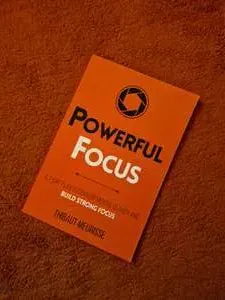
Powerful Focus
Summary
"Powerful Focus" presents a structured, week-long program designed to combat the growing epidemic of distraction and mental fragmentation. Thibaut Meurisse, continuing his series of concise, action-oriented self-improvement guides, offers a systematic approach to developing what he calls "focused intelligence"—the ability to direct and sustain attention on demand.
The book is organized as a progressive 7-day plan, with each day targeting a different aspect of focus: from eliminating environmental distractions and managing digital inputs to strengthening cognitive stamina and developing deep work routines. What distinguishes Meurisse's approach is his balanced consideration of both external factors (environment, technology, time management) and internal conditions (mindset, energy management, mental training).
Rather than offering generic advice to "just focus harder," the book provides concrete practices and measurable targets for each day. Meurisse emphasizes that powerful focus isn't merely about concentration but about cultivating mental clarity that allows you to identify what deserves your attention in the first place. The result is a practical guidebook for anyone seeking to regain control of their attention in an increasingly fragmented world.
Key Takeaways
1. Focus Audit Process
Systematically tracking where your attention goes throughout the day reveals patterns and triggers of distraction that would otherwise remain invisible.
2. Attention Residue Minimization
Task switching creates mental "debris" that impairs focus; structured transition practices between activities dramatically improve mental clarity.
3. Focus-Friendly Environment Design
Your physical and digital spaces can either support or sabotage attention; strategic design choices reduce the willpower needed to maintain focus.
4. Psychological Priming Techniques
Using consistent pre-work rituals sends powerful signals to your brain that activate focused states more quickly and reliably.
5. Focus as a Trainable Capacity
Focus works like a muscle—progressive overload techniques can systematically increase your attention span and depth over time.
Favorite Quotes
Personal Reflection
As someone who has struggled with maintaining focus in an age of constant notifications and information overload, I found Meurisse's systematic approach refreshingly practical. The focus audit exercise on Day 1 was particularly eye-opening—I discovered I was being interrupted nearly three times more frequently than I had estimated, often by my own habitual phone checking.
The concept of "attention residue" resonated strongly with me. Before reading this book, I would frequently switch between projects, believing I was being efficient. Implementing Meurisse's transition rituals—taking two minutes to properly close one task before beginning another—has noticeably improved my mental clarity and reduced the foggy, scattered feeling I used to experience by mid-afternoon.
I appreciated the book's emphasis on both environment design and mental training. Removing obvious distractions produced immediate benefits, while the progressive focus exercises have helped me build longer periods of sustained attention over time. The 25-minute focused work intervals suggested in the book initially felt challenging, but after several weeks of practice, I can now maintain deep focus for 45-50 minutes consistently.
While the 7-day structure provides a helpful framework, the real benefits came from incorporating these practices into my daily routine beyond the initial week. The book could perhaps benefit from more guidance on maintaining these habits long-term, but overall, it provides an excellent foundation for anyone looking to reclaim their attention in a distracted world.
Who Should Read This
This book is ideal for:
- Knowledge workers who need sustained concentration for complex tasks
- Students struggling with study focus and information retention
- Professionals experiencing frequent mental fatigue and scattered attention
- Anyone who feels their productivity is undermined by digital distractions
- Creative individuals seeking to achieve flow states more consistently
- People who prefer structured, actionable plans over theoretical concepts
- Those looking to improve their mental performance without major lifestyle changes